How to send a changed itinerary to clients without confusion
After an airline retime or a hotel swap: what to tell clients, how to mark each change, keep one current version, confirm they saw it and what EU rules require.
Short answer: send one message per change that shows the old and the new detail side by side, says what the client must do and by when, and names the version of the trip that is now current. Forward airline changes the day they reach you, keep the date you did, and ask every traveler to confirm. For packages sold in the EU, put significant changes on a durable medium, such as an email, with a deadline to accept or cancel.
Airlines retime flights, hotels overbook and move guests, transfer companies change pick-up times. None of this is the agency’s fault, but the client hears about it from you, and the way you tell them decides whether they turn up at the right airport at the right hour. This guide covers what to say, how to mark changes so nobody reads an old version, how to confirm the client saw it, and what EU rules say about schedule changes and notice. It is practical guidance, not legal advice.
What should a change message to a client say?
A good change message answers four questions before the client has to ask: what changed, what it means for them, what they need to do and by when, and which version of the trip is now the right one. Everything else can go in the trip itself.
| Part of the message | Example |
|---|---|
| What changed, old and new | “Your flight to Lisbon on 12 May now leaves at 07:10 instead of 09:45.” |
| What it means for the client | “Check-in now closes at 06:20, so the pick-up moves to 04:50.” |
| What they need to do, and by when | “Please reply by Friday 18 April to accept the new time, or call us to discuss other options.” |
| Which version is current | “Your trip is now version 3, dated 15 April. Earlier versions are out of date.” |
Write times as the client will live them: local time at the airport or the hotel, with the day of the week. Put the new value first and in bold, and the old value next to it, so a client reading on a phone in a queue sees the change at a glance. If the change knocks on to other bookings, such as an earlier pick-up or a late hotel check-in, say so in the same message instead of sending three messages in an afternoon.
Send it to every traveler on the booking, not only the person who paid. A couple, a family or a school group may each read their own copy of the trip.
If the change moves a time into another time zone or onto a clock change, our guide to time zones and daylight saving time in itineraries shows how to write it so nobody misreads it.
What do EU rules say when an airline changes the schedule?
Under Regulation 261/2004, a retime can legally be a cancellation. The EU’s air passenger rights page says a flight brought forward by more than one hour counts as canceled, and the European Commission’s 2024 interpretative guidelines add that a departure postponed by less than three hours, with no other change, is not a cancellation.
When a flight is canceled, the passenger can choose between a refund, rerouting at the earliest opportunity or rerouting at a later date. Compensation depends on when they were told, according to the same EU page, last checked by the EU on 21 September 2026:
| When the passenger was told | Compensation under Regulation 261/2004 |
|---|---|
| 14 days or more before departure | None |
| Between 14 and 7 days before | None if the rerouting leaves no more than 2 hours earlier and arrives less than 4 hours later than planned |
| Less than 7 days before | None if the rerouting leaves no more than 1 hour earlier and arrives less than 2 hours later than planned |
| Otherwise | EUR 250 (up to 1,500 km), EUR 400 (1,500 to 3,500 km, or longer flights within the EU), EUR 600 (over 3,500 km), unless the airline proves extraordinary circumstances |
The amounts can be halved when the rerouted flight arrives within set limits, and the Commission’s guidelines say that reduction does not apply when the flight was brought forward. These are the airline’s obligations, not yours. Your part is to pass the news on fast and to point clients to the official page instead of promising an amount.
Why the date you forward a change matters
In Case C-302/16, Krijgsman, the airline told the online travel agency about a cancellation on 9 October 2014, and the agency told the passenger on 4 November, ten days before departure. The Court of Justice ruled on 11 May 2017 that the airline still had to pay the passenger, because it could not prove the passenger had been told more than two weeks ahead. The Court also noted that the airline can seek compensation from whoever caused the failure, under national law.
The Commission’s guidelines apply the same reasoning to a booking where the only email address the airline received was the agent’s. For an agency this means two things:
- Give airlines the passenger’s own contact details when the client agrees. IATA’s customer portal says that under Resolution 830d agents should provide the passenger’s mobile number and/or email address in the booking, using the contact elements CTCE and CTCM.
- When a change reaches your inbox instead, forward it the same day and keep a record of when you did.
What if the client flies from the United States?
US rules work differently. The US Department of Transportation’s refund rule defines a significantly changed flight as one that departs 3 hours or more earlier or arrives 3 hours or more later on a domestic itinerary (6 hours on an international one), or that changes the airport, adds a connection or downgrades the cabin, among other cases. The rule makes the passenger eligible for a refund if they decline the new schedule. Tell clients to choose before they accept anything the airline offers.
What does the Package Travel Directive ask of you?
If you sell packages in the EU, you are not only passing on news: you are the organiser or the retailer, and the Package Travel Directive sets out how changes reach the traveler. Its Article 5 lists the main characteristics of a package, including the dates and times of departure and return and the location, main features and tourist category of the accommodation. A retimed flight or a different hotel can therefore touch a main characteristic.
Article 11 sets the rules before the package starts:
- Small changes. The organiser can make an insignificant change unilaterally only if the contract reserves that right and the traveler is told “in a clear, comprehensible and prominent manner on a durable medium”.
- Significant changes. If a main characteristic has to change significantly, the traveler can accept the change or end the contract without a termination fee.
- What the notice must contain. Without undue delay, the organiser tells the traveler on a durable medium of the change and its effect on the price, a reasonable period to decide, what happens if the traveler does not reply within it (national law decides that), and any substitute package offered.
- Refund. If the traveler ends the contract and takes no substitute, the organiser refunds everything without undue delay and no later than 14 days after termination.
Price increases follow their own rule. The EU’s package travel page says an increase cannot be applied later than 20 days before the start of the package, and a rise of more than 8% of the total price lets the traveler end the contract without a fee.
A durable medium is, in the Directive’s words in Article 3(11), an instrument that lets the traveler store information addressed personally to them and reproduce it unchanged. An email or a PDF attached to one usually fits. A web page you can edit at any time may not: in Case C-49/11, Content Services, a 2012 distance-selling case, the Court of Justice held that information made available only through a hyperlink to the seller’s website had not been given on a durable medium. So when a package changes, update the trip and also send the change in an email.
How do you mark changes so nobody reads an old version?
Confusion after a change rarely comes from the change itself. It comes from two versions of the trip living side by side: the PDF from March in one inbox, a WhatsApp message with the new time in another, and a printed copy in the client’s bag.
- Number or date every version. “Version 3, 15 April” at the top of the trip and in the message. If the client quotes a version, you know which one they are looking at.
- Keep one current version. Replace the trip, do not add a second one. If you send files, say in the subject line which file replaces which, and ask clients to delete the old one.
- Mark what changed inside the trip. Show the new value with the old one struck through, or a short “Changed on 15 April” line on the booking, until the trip is over.
- Keep the old versions. You may need to show what the client was sent and when, in a dispute or a compensation claim. Keep the history, with dates.
- Change the knock-on items at the same time. A new flight time moves the transfer, sometimes the hotel check-in and the first dinner. Update them in the same version so the client never sees half a change.
How easy this is depends on how you sent the trip in the first place: our comparison of PDF, link and app covers what each does when something changes.
How do you confirm the client has seen the change?
Ask for a reply, and treat silence as “not seen yet”, not as agreement. For packages, the Directive leaves the consequences of no reply to national law, so state them in the notice and keep it.
- Ask each traveler to confirm. A one-line reply such as “Seen, we accept the new time” is enough. Keep it with the booking.
- Set a deadline that leaves room. For a package, the deadline is the “reasonable period” of Article 11. Whatever the date, leave time to rebook if the client says no.
- Escalate before departure. No reply 72 hours before the first changed booking? Call. A missed email is common; a missed phone call and email together are rare.
- Check the details close to departure. Airlines can retime more than once. Check the booking again a few days before the client leaves, and again on the eve of any leg that changed.
Read receipts and app signals help as a second check. They tell you a message was opened, not that the client understood that the pick-up is now at 04:50.
How does Viaondo handle a changed trip?
We make Viaondo, so this is the one section about our own product. In Viaondo the agency edits a draft, and nothing reaches the client until it publishes a new version. The publish dialog runs a check of the trip and lists what changes for travelers: times, places, hotels and documents, compared with the version they have. Published versions stay fixed, and the trip’s history lists them with who published each one (the current version, the last 20 and any from the last 90 days). In the traveler app, the client sees a notice that a new version exists, with the old time and the new one, and their offline copy updates when they tap Update; the offline and updates page shows how.
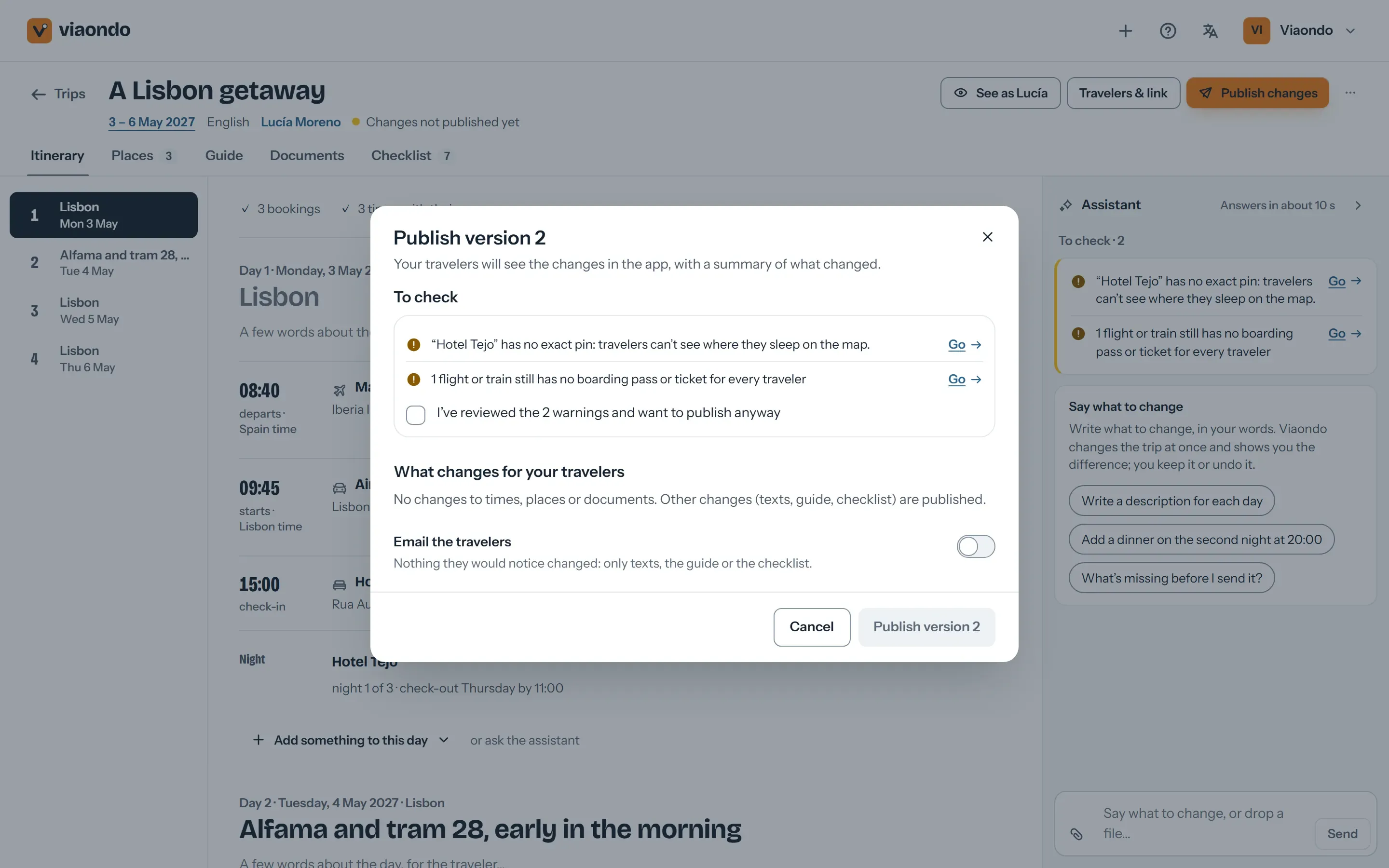
When you publish you can also email each traveler, in their own language, with their changes and the link to their trip. It is a choice you make on every publish, not a default you can rely on, so tick it for any change a client has to act on. The trip’s activity records when a traveler opens the trip and when they update to the latest version, by name when each traveler has their own link. The limits: a phone that stays offline keeps the old copy until it connects, the app notice is not a durable medium on its own, and the activity tells you the trip was updated, not that the client agreed. Ask for the reply anyway.
Checklist: sending a changed itinerary
- Read the airline’s or supplier’s notice and note the date and time it reached you.
- Work out the knock-on effects: transfers, check-in times, connections, the first activity.
- If you sell the trip as a package, decide whether the change is significant under Article 11 of the Package Travel Directive. If it is, prepare the options and a deadline.
- Update every affected booking in one new version of the trip, numbered or dated.
- Write one message per change with the old and new values, what the client must do, by when, and the version number.
- Send it to every traveler the same day, by email at least, and keep a copy.
- For a flight change, link the EU’s air passenger rights page and say that the airline decides any compensation.
- Record each traveler’s reply. No reply 72 hours before the changed booking? Call.
- Check the booking again a few days before departure, in case the airline retimes it again.
- Keep a copy of every version and message you sent until any claim period is over, outside your itinerary tool if it prunes old versions.
If you also keep a standing note in the trip, such as the border note from our guide to the EU Entry/Exit System, treat an update to it as a change too: date it and tell clients it moved.
What should you not tell a client after a schedule change?
- Do not promise compensation, or tell a client they have none. The airline decides first, and national enforcement bodies and courts after it.
- Do not judge whether a cause was an “extraordinary circumstance”. That is for the airline to prove.
- Do not let the client accept an airline’s voucher before you have told them a refund may be an option.
- Do not send a new version without saying what changed. A client should never have to compare two itineraries line by line.
How this guide was checked. Every rule links to an official source: the EU’s Your Europe pages, EUR-Lex, the Court of Justice and the European Commission, plus IATA for agency booking practice and the US rule through Cornell’s Legal Information Institute. All were opened on 15 October 2026. The Viaondo section describes the product as it works on that date. This is practical guidance for agencies, not legal advice.
To compare how itinerary tools handle versions and changes, see our guide to itinerary software for travel agencies.
Sources
- Your Europe (EU): air passenger rights, cancellations and compensation (last checked 21 September 2026) (accessed 15 October 2026)
- EUR-Lex: Regulation (EC) No 261/2004 on compensation and assistance to air passengers (accessed 15 October 2026)
- European Commission: Interpretative Guidelines on Regulation (EC) No 261/2004 (C/2024/5687), sections on change of departure time and on the obligation to inform passengers (accessed 15 October 2026)
- Court of Justice of the EU: press release 51/17 on Case C-302/16, Krijgsman (11 May 2017, PDF) (accessed 15 October 2026)
- EUR-Lex: Package Travel Directive (EU) 2015/2302, Articles 3(11), 5(1), 10 and 11 (accessed 15 October 2026)
- Your Europe (EU): package travel and linked travel arrangements (last checked 11 May 2026) (accessed 15 October 2026)
- EUR-Lex: judgment of the Court of Justice in Case C-49/11, Content Services (5 July 2012) (accessed 15 October 2026)
- IATA customer portal: is it mandatory for travel agents to provide the passenger’s mobile phone and email address? (Resolution 830d) (accessed 15 October 2026)
- Legal Information Institute (Cornell): 14 CFR § 260.2, definition of a significantly delayed or changed flight (US) (accessed 15 October 2026)