Skip to content

Esta página también está en español.

Ver en español

Esta página também está em português.

Ver em português

Cette page existe aussi en français.

Questa pagina è disponibile anche in italiano.

Diese Seite gibt es auch auf Deutsch.

Deze pagina is ook in het Nederlands beschikbaar.

Ta strona jest też dostępna po polsku.

Zobacz po polsku

Bu sayfa Türkçe olarak da mevcut.

Türkçe görüntüle

Den här sidan finns även på svenska.

Schengen 90/180 calculator

Visitors from outside the EU can spend up to 90 days in any 180-day period in the Schengen area. Enter the stays and check how many days are used, how many are left and how long the next stay can last.

Stays in the Schengen area

You’re looking at an example. Change anything to make it yours.

Stays (past and planned)

Usually the day of the next entry. The 180 days are counted back from this date.

Result

Add at least one stay to see the days used.

An estimate for short stays. The entry and exit days both count. Border guards decide using the Entry/Exit System records. Long-stay visas, residence permits and bilateral agreements aren’t taken into account.

Two worked examples

One earlier trip, planning the next

Your client spent 1 March to 30 April 2027 in the Schengen area: 61 days, counting both the entry and the exit day. They want to enter again on 1 July 2027. The 180 days counted back from 1 July start on 3 January 2027, so the whole spring trip is still inside the window: 61 days used, 29 left. They can stay from 1 to 29 July 2027.
A full 90 days, then a short break

Your client stayed from 1 February to 1 May 2027, exactly 90 days, and wants to come back on 20 May. The window for 20 May starts on 22 November 2026 and still holds all 90 days, so none are left. The first day they can enter again is 31 July 2027, when 1 February drops out of the window. From then on, each day that drops out frees one more.

The Entry/Exit System now does the counting

Since 10 April 2026 the Entry/Exit System (EES) has been fully operational at the Schengen area’s external borders. It records each entry and exit of travelers from outside the EU, so the days used come from those records instead of passport stamps. The 90/180 rule itself hasn’t changed. Our guide to the EES for travel agencies covers what to tell clients before they fly. For a borderline case, check the dates again with the European Commission’s short-stay calculator.

Checked against the European Commission’s calculator

On 11 October 2026 we entered the same eight cases into the European Commission’s short-stay calculator and into this one. For each case, the longest stay allowed from the planned entry was the same in both.

Earlier stays Planned entry Days allowed
10 Jan – 8 Feb 2027 1 May 2027 60
1 Jan – 31 Mar 2027 15 April 2027 0
1 – 28 Feb 2027 · 1 – 30 Apr 2027 1 June 2027 32
1 Dec 2026 – 15 Jan 2027 · 1 – 20 Mar 2027 10 May 2027 70
1 Jan – 1 Mar 2027 15 June 2027 90
1 Mar – 30 Apr 2027 1 July 2027 29
1 Feb – 1 May 2027 20 May 2027 0
5 – 25 Jan 2027 · 10 Feb – 12 Mar 2027 · 1 – 20 Apr 2027 15 May 2027 18

Sources

  1. European Commission: Schengen area (accessed 10 October 2026)
  2. European Commission: Border crossing (the 90/180 rule and the Entry/Exit System) (accessed 10 October 2026)
  3. European Commission: Short-stay calculator (accessed 10 October 2026)
  4. Regulation (EU) 2016/399, Schengen Borders Code, Article 6 (accessed 10 October 2026)

How the 90/180 rule works

A rolling window

On any given day, look back 180 days (that day included) and count the days spent in the Schengen area. The total can’t be more than 90.

Entry and exit days count

A trip from Monday to Friday is five days. Days in different Schengen countries add up: the area counts as one.

Days come back over time

As old stays drop out of the 180-day window, their days become available again. The calculator finds the longest stay possible from the date you check.

Add it to your site

Put the Schengen calculator on your blog or agency website: readers enter their past and planned stays and see the days left, on your page. Copy the code; the stays they enter stay in their browser, and the widget has no cookies or tracking.

Questions about the Schengen 90/180 rule

Which countries are in the Schengen area?
Twenty-nine: every EU country except Ireland and Cyprus, plus Iceland, Liechtenstein, Norway and Switzerland. Bulgaria and Romania have been full members since 1 January 2025, according to the European Commission’s Schengen area page.
Who does the 90/180 rule apply to?
To non-EU travelers on short stays, with or without a visa (for example, travelers from the United States, the United Kingdom, Canada or Australia). It doesn’t apply to EU citizens or to residence permit holders in their country. Brazilian citizens are covered by an EU visa waiver agreement that, as the Commission notes, still counts 3 months within the 6 months after the first entry.
Is this calculator official?
No. It follows the rule as the European Commission describes it, but at the border what counts are the dates recorded by the Entry/Exit System; read what the Entry/Exit System changes for your clients. For borderline cases, use the Commission’s own short-stay calculator or ask the consulate.
How long do I wait after 90 days before I can return?
There is no fixed waiting period. The 90 days are counted in a rolling 180-day window, so days become available again as old stays drop out of it. Enter your stays and the date you want to enter: the calculator shows how many days are left or, if there are none, the first day you can enter again.
Do the entry and exit days both count?
Yes. The Schengen Borders Code treats the day of entry as the first day of the stay and the day of exit as the last, however late you arrive or early you leave. A trip from 1 to 5 June uses five days.
Does the count start again if my client leaves the Schengen area?
No. Days outside the area aren’t counted, but the days already spent stay in the 180-day window until they drop out of it. Only time passing frees days.
Do days in Ireland or Cyprus count?
No. Ireland is outside the Schengen area, and Cyprus has not yet joined it fully, so days there aren’t part of the 90/180 count. Each applies its own national entry rules.
Do days with a residence permit or a long-stay visa count?
No. Days spent in a Schengen country under that country’s residence permit or long-stay visa aren’t counted as short-stay days. The calculator doesn’t know about them, so leave those days out when you enter the stays.
What happens if a client stays longer than 90 days?
The Entry/Exit System records every entry and exit, so the border sees the overstay when the client leaves. Each country sets its own penalties, which can include a fine and a ban on entering again. Plan stays so they end inside the 90 days.
Can I put this calculator on my agency’s website?
Yes, for free. In the “Add it to your site” section of this page, copy the embed code and paste it into your page. The widget has no cookies or tracking.

Entry rules in the trip, where the client sees them

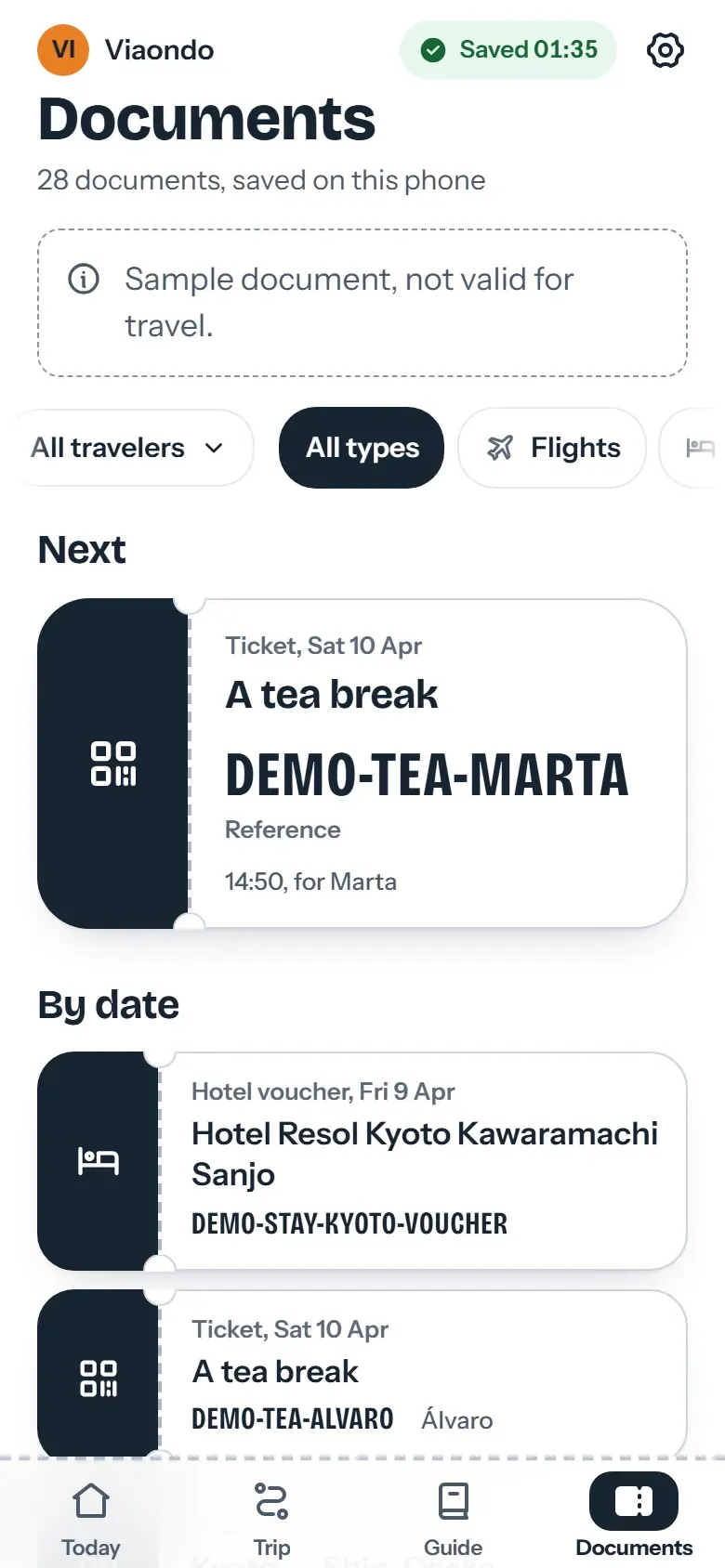
With Viaondo, the entry notes sit next to your client’s travel documents and daily plan in their trip app. All of it opens offline, in the client’s language.

Documents screen of the traveler app with each traveler’s tickets and the hotel voucher, saved for offline use
Travel documents sit in the trip app, filed by traveler and saved on the phone for use offline.

Add it to your site

Preview

Size

No cookies or tracking inside the widget. What it shows travels in the code; nothing is stored on our servers.

If it helps your readers, a link to the tool in your article is the best way to thank us.