Skip to content

Esta página también está en español.

Ver en español

Esta página também está em português.

Ver em português

Cette page existe aussi en français.

Questa pagina è disponibile anche in italiano.

Diese Seite gibt es auch auf Deutsch.

Deze pagina is ook in het Nederlands beschikbaar.

Ta strona jest też dostępna po polsku.

Zobacz po polsku

Bu sayfa Türkçe olarak da mevcut.

Türkçe görüntüle

Den här sidan finns även på svenska.

Viaondo vs Axus

Axus is an itinerary and collaboration platform for travel advisors, with a store app for travelers, supplier and DMC collaboration, GDS and CRM integrations, and a price per seat. Viaondo delivers every trip as a web app with your brand, opened from a private link, for a flat price per agency. If you work with DMCs and a GDS and want an app in the stores, Axus is the better fit. Choose Viaondo if you want clients to open the trip without signing in or downloading an app, with your whole team on one price.

How do Viaondo and Axus compare, point by point?

Viaondo Axus
Price US$50/month, plus VAT where it applies $35/month per seat, or $329/year per seat; DMCs and tour operators on request
Pricing model Per agency, team included Per seat; consortia, team and volume pricing on request
Traveler app with your brand Yes, included Your logo and contact details in the Axus app; your own store app on request, no public price
Works offline Yes, except the street map Yes, in the app, per its App Store and Google Play listings
App languages Ten languages Itinerary headings in English, Spanish, French, Portuguese, German and Italian; the App Store listing shows English
AI booking import Yes: PDFs, images and emails Yes: AxusBuilder reads pasted text, PNRs, PDFs or images, and you review the result
Data hosted in the EU Yes (database and files) No: stored and processed in the United States, per its privacy policy
Setup fee No setup fee Not stated
Free trial 14 days, card required 14 days, no credit card
Annual billing US$500/year: two months free Yes: $329/year per seat, 21% less than monthly
App Store and Google Play app No (web app) Yes, plus a web view link and a PDF
Messaging and flight alerts No chat or flight tracking; push reminders Yes: in-app messaging, push notifications on changes and flight updates
How the client opens the trip A private link that opens in the browser An email with a UserID and passcode, a web preview link and an app invite
GDS and CRM integrations Not included GDS PNR import, CRM integrations such as ClientBase, and an API

Facts checked on . Prices and features may change. Updated . Facts checked by Pablo Bravo.

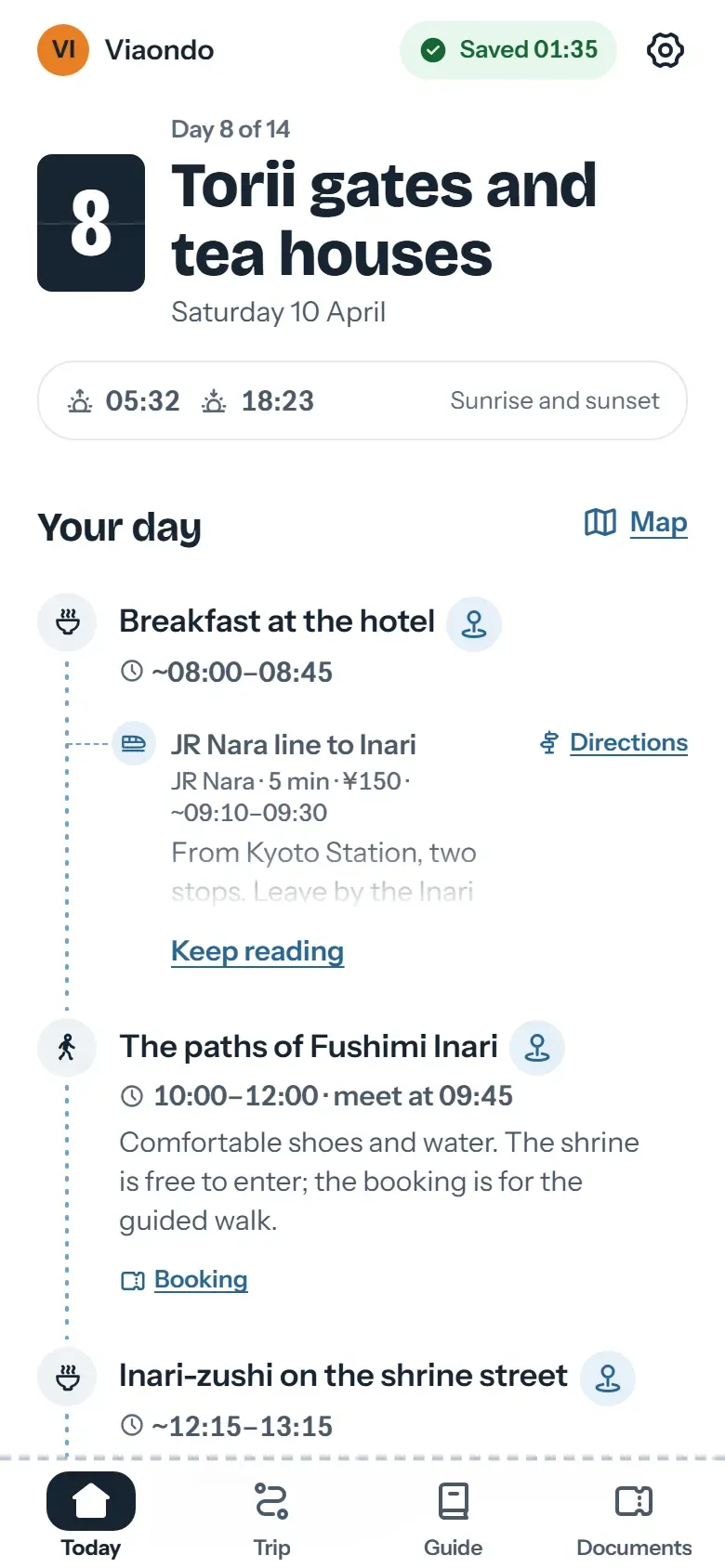
Today screen of the traveler app in Kyoto: the agency’s name at the top, then the next plan with its meeting time and time zone
What your client opens from the link: your agency’s name at the top, and every time in local time with its time zone.

What does Axus do better than Viaondo?

Axus is built for advisors who work with many suppliers and partners, and it covers several things Viaondo doesn’t do:

  • Collaboration with DMCs and suppliers. You can invite any DMC or travel planner, anywhere, to work with you on the same itinerary from start to finish.
  • Supplier content. Axus gives you access to over 4 million images, travel42 destination guides, a global accommodation search, port-by-port cruise schedules and a Google-powered search for restaurants, spas and golf courses.
  • GDS and back-office connections. It imports PNRs from your GDS, parses confirmation emails through AwardWallet, connects with CRM systems such as ClientBase and offers an API. In Viaondo, bookings come in from documents you upload.
  • An app in the stores, plus web and PDF. Travelers use the Axus app for iOS and Android, a web view link or a PDF. You can also request your own branded app in the stores. Viaondo is a web app only.
  • Messaging and flight alerts. Travelers can message you in the app, and Axus sends push notifications for changes and confirmed flight updates.
  • Content translation and proposals. Axus can translate itinerary content with AI and lets you draft proposals and E-Pages.

How is Axus priced?

Axus charges per seat: $35/month, or $329/year billed annually, which Axus puts at 21% less than paying monthly. DMCs and tour operators, consortia and larger teams get pricing on request, and so does a branded app in the stores. The trial lasts 14 days with no credit card.

One seat costs less than Viaondo’s US$50/month. Three seats cost $105/month, or $987/year billed annually, against US$50/month or US$500/year for the whole agency on Viaondo, plus VAT where it applies.

When is Viaondo the better choice?

Viaondo is the better choice when you want the client to open the trip with no credentials and the team to share one price:

  • You want clients to open the trip without credentials. With Viaondo, a private link opens the traveler app in the browser. Your client has no UserID or passcode to type and nothing to download from a store.
  • You work as a team. One price for the agency instead of one per seat. Details on pricing.
  • You care where your data lives. Viaondo’s database and files are stored in the EU. Axus says its platform is operated from the United States and data is stored and processed there.
  • Your clients speak other languages. Axus translates itinerary headings into six languages and its App Store listing shows English. Viaondo’s app and dashboard work in ten, including Dutch, Polish, Turkish and Swedish.

Who should stay on Axus?

Stay on Axus if you build itineraries together with DMCs and other planners, or if your bookings come from a GDS: Viaondo has no shared editing with outside partners and no PNR import. The same goes if you rely on its destination content and image library to fill trips, or if your clients chat with you inside the app and expect flight update alerts.

A solo advisor also pays less there, at $35/month or $329/year for one seat. Moving to Viaondo makes sense for a team of two or more that writes its own trip content and wants clients to open the trip from a link.

How does your client open the trip?

According to Axus, the first published itinerary sends the traveler an email with a UserID and passcode, a web preview link and an invite to download the app. In Viaondo, you share a group link with the whole trip, or a personal link for each traveler with their own documents and seats.

How are bookings loaded?

Both tools use AI to read booking documents. AxusBuilder reads pasted text, PNRs, PDFs or images, and adds GDS PNR import and vendor connections. In Viaondo, booking import puts each flight, hotel, train, transfer or activity into the trip’s draft with its local time and the document it came from, and lists anything it couldn’t be sure of under To confirm.

How do you move from Axus to Viaondo?

Viaondo doesn’t connect to Axus, so you start from your documents rather than from your Axus itineraries or PNRs. Upload the PDFs, screenshots or confirmation emails of your next departures, check what’s listed under To confirm and publish. If you used Axus content for descriptions, write your own or duplicate a past Viaondo trip.

Trips already in progress can finish in Axus, so no traveler loses the app mid-trip. Start with the 14-day free trial, or open the example app to see what your client will receive.

Sources

  1. Axus Travel App: features and pricing (accessed 25 September 2026)
  2. Axus: Privacy Policy (accessed 25 September 2026)
  3. Axus on the App Store (accessed 25 September 2026)
  4. Axus Travel App on Google Play (accessed 25 September 2026)
  5. Axus Help: Select a Language Option (accessed 25 September 2026)
  6. Axus Help: How will my clients receive the link to download AXUS Travel App? (accessed 25 September 2026)
  7. Axus Help: Importing travel bookings using confirmation emails (accessed 25 September 2026)
  8. Axus Help: Flight Update Alerts and How to Refresh Flight Information (accessed 25 September 2026)
  9. Axus Help: Online Itinerary (Webview) (accessed 25 September 2026)

Frequently asked questions

What would a team of three pay?
With Viaondo, US$50/month per agency, plus VAT where it applies, team included (fair use). With Axus, $35/month per seat, so $105/month for three, or $329/year per seat billed annually, $987/year for three. Axus offers team and volume pricing on request.
Do my clients have to sign in or download an app?
With Viaondo, no: they open the trip from a private link and can add it to their home screen. According to Axus, the first time you publish, the traveler gets an email with a UserID and passcode, a link to preview the web itinerary and an invite to download the app.
Does Viaondo have chat or flight alerts like Axus?
No in-app chat and no live flight tracking. Your client messages you on WhatsApp from the button in the app, and when you publish a change they see what changed and can get an email notice. Travelers who opt in also get push reminders: the evening before the trip, when it’s time to leave, at boarding and a daily brief (they turn them off under More). Axus offers in-app messaging and pushes flight updates to the app once you confirm them.
Does Viaondo translate the trip content?
Partly. Viaondo writes the trip in the language you choose for it, and when an imported program document is in another language it offers to translate the days and the bookings’ notes into the trip’s language, which you check before adding. The app’s screens follow each traveler’s language, out of ten. Axus translates itinerary headings and labels and, according to its privacy policy, can translate itinerary content with AI.

See it with your own trips

14 days free, no lock-in. Import a real trip and see how your client receives it.