What does Wetu do better than Viaondo?
Wetu started as a place where suppliers keep their content up to date and share it with the trade. That supplier side is still its core, and Viaondo doesn’t cover it.
- Supplier content. Wetu’s library holds more than 250,000 images and descriptions of lodges, hotels, activities and destinations, and suppliers maintain their own profiles. In Viaondo, you write your own content and duplicate a finished trip to reuse it.
- Proposals and costing. Wetu itineraries work as proposals, with themes, a theme customizer, reusable components and an Excel costing spreadsheet. Viaondo starts once the trip is sold and has no proposals or quotes.
- An app in the stores. On Premium, travelers get TravelKey for iOS and Android, which works offline. Viaondo is a web app and isn’t in the App Store or Google Play.
- Integrations with operator systems. Wetu connects with Tourplan, ResRequest, Dolphin, Travelogic, Tour32, Lemax, Nitro and Travefy, among others, and has a Connect API on its Enterprise plan. It also imports flights from a GDS booking (PNR).
- Working with agents and operators. Wetu Share sends itineraries straight to an agent’s Wetu account, and identities let you switch between your brand, an agent’s brand or co-branding.
- More itinerary languages. Premium translates itineraries into 17 languages, including Norwegian, Danish and Catalan, plus others in beta.
How is Wetu priced?
Wetu charges per user, excluding VAT. Lite costs $75/month for one user and $35/month for each extra one; Premium, which adds the TravelKey app and translation into 17 languages, costs $150/month plus $65/month per extra user. You can pay monthly, quarterly, twice a year or annually, and the 12th month is free on annual billing. The trial lasts 14 days with no credit card.
A team of three pays $145/month on Lite or $280/month on Premium. Viaondo is US$50/month for the agency, plus VAT where it applies, and its traveler app is part of the single plan rather than a higher tier.
When is Viaondo the better choice?
Viaondo is the better choice when you sell your own way and write your own trips:
- You want better delivery, not a proposal tool. If you already quote and sell by email, spreadsheets or your booking system, Viaondo covers the part your client sees: the traveler app.
- You work as a team. One price for the agency instead of one per user. Details on pricing.
- You want to load bookings from documents. Booking import reads PDFs, screenshots and confirmation emails and puts each item into your draft with its local time and the document it came from. Wetu doesn’t publish a document import of this kind.
- Your clients want the app itself in their language. The TravelKey App Store listing shows English; Wetu translates the itinerary, not the app. Viaondo’s app and dashboard work in ten languages, Turkish included.
Who should stay on Wetu?
Stay on Wetu if your itineraries are built from supplier content: a safari operator or DMC that pulls lodge descriptions and photos from the library, costs the trip in its spreadsheet and sends it as a proposal would have to write all of that by hand in Viaondo. The same goes if your trips flow in from Tourplan, Lemax or another connected system, or if you exchange itineraries with agents through Wetu Share and switch between their brand and yours.
Both keep data in the EU (Wetu B.V.’s privacy notice names EU hosting providers), so that isn’t a reason to move. Viaondo fits the agency that sells trips it writes itself and wants each client to get a branded app without a code or a download.
How does your client open the trip?
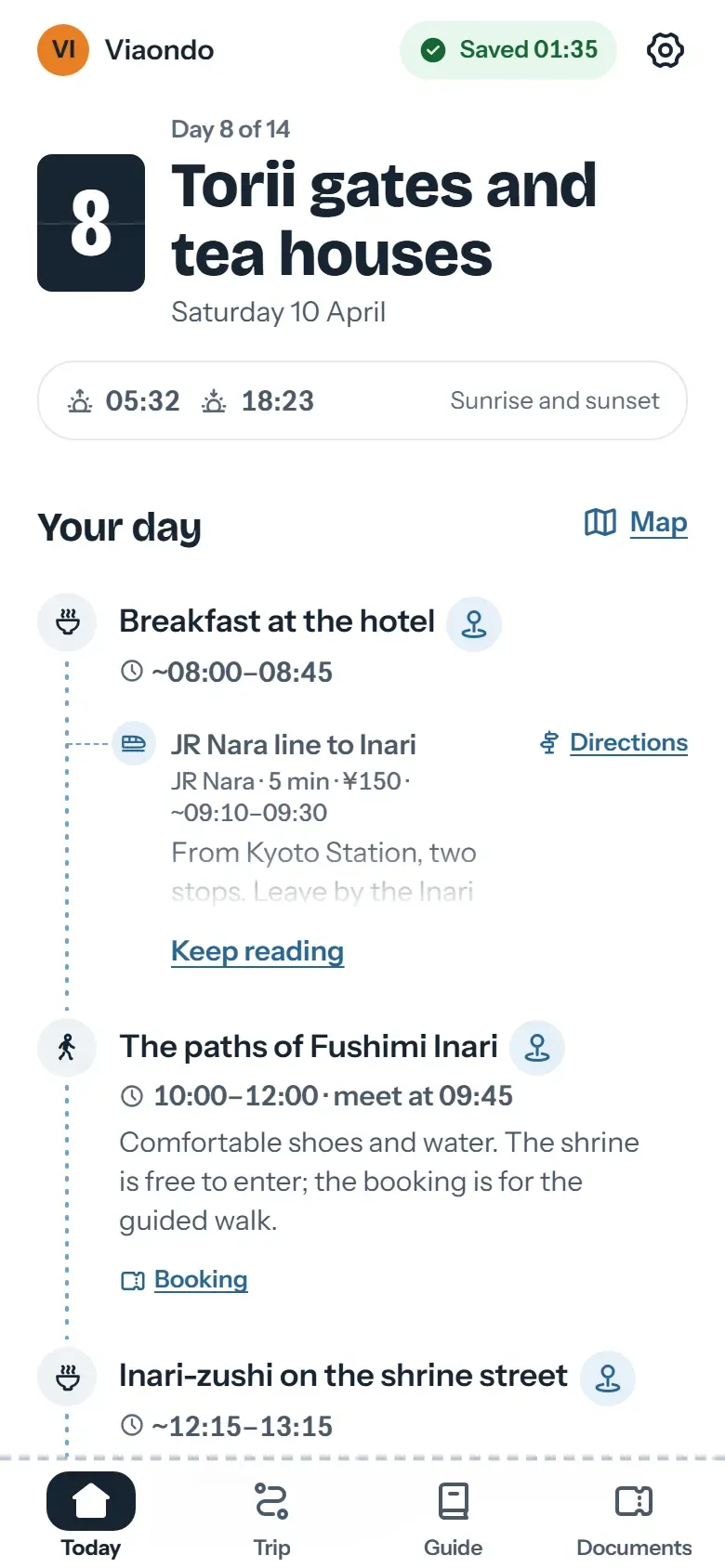
With Wetu, you share a web itinerary, a printable version or, on Premium, the TravelKey app, which travelers download and open with a code from their agent. With Viaondo, the link opens the trip straight in the browser: a group link for the whole trip, or a personal one per traveler with their own documents and seats.
How do you move from Wetu to Viaondo?
Viaondo doesn’t connect to Wetu, and supplier content from its library doesn’t come over. Upload the PDFs, screenshots or confirmation emails of your next departures; flights, hotels, trains, transfers and activities go into the draft with their local times. For a route you sell again, duplicate a finished trip: its dates shift to the new departure.
Trips already in progress can finish in Wetu. Start with the 14-day free trial, or open the example app without an account to see what your client will receive.