Skip to content

Esta página también está en español.

Ver en español

Esta página também está em português.

Ver em português

Cette page existe aussi en français.

Questa pagina è disponibile anche in italiano.

Diese Seite gibt es auch auf Deutsch.

Deze pagina is ook in het Nederlands beschikbaar.

Ta strona jest też dostępna po polsku.

Zobacz po polsku

Bu sayfa Türkçe olarak da mevcut.

Türkçe görüntüle

Den här sidan finns även på svenska.

Jet lag calculator

Enter where you’re flying from and to and when you usually sleep. You get the time difference, how long adjusting can take and a plan that shifts your sleep by an hour a day before the flight.

Your flight

Your flight

You’re looking at an example. Change anything to make it yours.

Jet lag plan

Pick where you’re flying from and to to see the plan.

During the trip

  • On the plane, set your watch to the destination’s time and eat and sleep by it.
  • Once there, get outside in daylight during the day and keep the bedroom dark at night.
  • Drink water and go easy on alcohol and caffeine, especially in the afternoon.
  • If you need a nap, keep it under 30 minutes and before mid-afternoon.

General guidance, not medical advice. Travelers with health conditions or on medication should ask their doctor.

Jet lag and your body clock

Your body runs on an internal clock of roughly 24 hours, the circadian rhythm. A small area of the brain acts as the master clock and keeps the rest of the body in step with day and night, mostly through light. In the evening, it tells the brain to make more melatonin, which makes you sleepy.

Jet lag happens when you cross time zones faster than that clock can follow. For a few days it keeps running on home time, which can mean trouble falling asleep or waking up, tiredness during the day, poor concentration and an upset stomach. It passes on its own as the clock catches up.

The CDC’s travel guidance puts the pace at about an hour a day flying east and about an hour and a half flying west: the clock runs a little longer than 24 hours, so it’s easier to push later than earlier. That’s why the plan above moves your sleep by an hour a day for up to three days before the flight.

Light is the strongest signal: morning light moves the clock earlier and evening light moves it later. Public-health advice is simple: shift your sleep before you go, drink water, go easy on alcohol and caffeine, and live on local time from the first day. For anything beyond general advice, such as sleeping pills or melatonin, ask a doctor or pharmacist.

Sources

  1. NHS: Jet lag (opens their site) (accessed 28 September 2026)
  2. CDC Yellow Book: Jet lag disorder (opens their site) (accessed 28 September 2026)
  3. NIH, National Institute of General Medical Sciences: Circadian rhythms (opens their site) (accessed 28 September 2026)

How the plan is made

The real time difference

We compare both places’ time zones on the travel date, daylight saving included. Differences over 12 hours are treated the shorter way round the clock.

One hour a day

Moving bedtime and wake-up time by an hour a day for up to three days before the flight means arriving partly adjusted: earlier when flying east, later when flying west.

Light and routine at the destination

Daylight is the strongest signal for the body clock. Living on local time from the first day speeds up adjustment.

A worked example: New York to Paris

A client flies from New York to Paris on Monday 14 June 2027 and usually sleeps from 23:00 to 07:00. Paris is six hours ahead, so the calculator gives about six days to adjust and a plan that starts three days before the flight: bed at 22:00 and up at 06:00, then 21:00 and 05:00, then 20:00 and 04:00 on the day before and on the travel day. In Paris, the client goes back to 23:00 and 07:00, local time.

Three hours of shifting covers half of the six-hour gap before the trip. The CDC puts the body clock’s pace at about an hour a day flying east, which is why the plan moves one hour a day and stops at three days.

Between 14 and 27 March 2027 the gap is five hours instead of six, because the United States changes its clocks two weeks before France. The calculator uses the travel date you enter.
For travel agencies

Jet lag decides how much a client can do on the first days. When you build the itinerary, keep the arrival day light after a long flight east, place tours that start early later in the trip, and show every time in the local time of its place, so nobody converts times half asleep.

Or try Viaondo free for 14 days

Add it to your site

Readers flying across time zones can plan their sleep on your page. Add the jet lag calculator to a long-haul destination guide: copy the code and paste it into your page. It works on its own, with no cookies or tracking.

Questions about jet lag

Why is flying east harder?
The body clock runs a little longer than 24 hours, so it’s easier to stay up later (flying west) than to fall asleep earlier (flying east).
How long does jet lag last?
As a rule of thumb, about a day for every hour of time difference, often less when flying west. Preparing before the trip and daylight at the destination shorten it.
Can I work out the arrival time instead?
Yes, with the arrival-time calculator, which gives you the local arrival time and day at the destination.

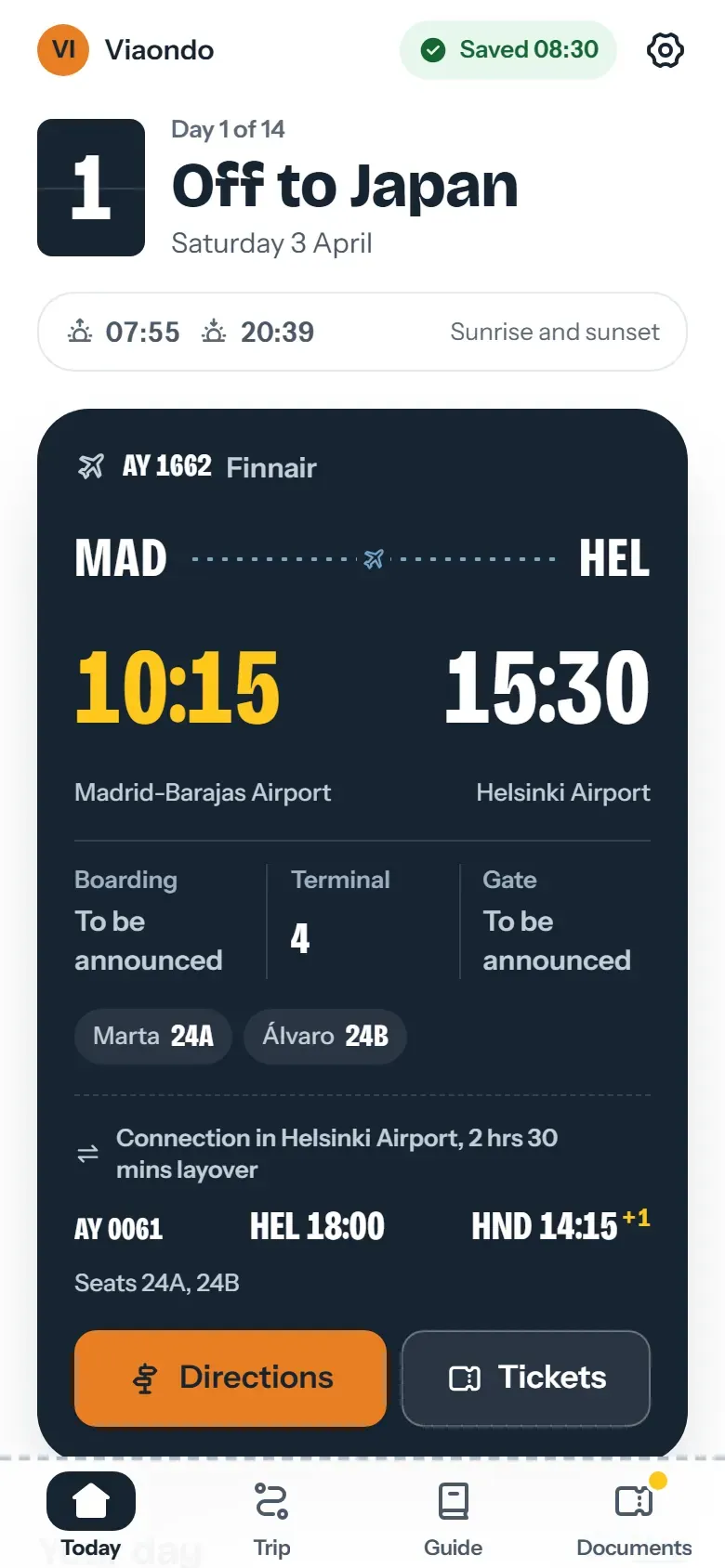
Every time already in local time

In Viaondo, each flight, transfer and activity is shown in its own place’s time, so your clients don’t have to convert times.

Flight card from Madrid to Helsinki with the departure and arrival in each airport’s local time
In the trip app, every time is shown in its own place’s time, with the zone’s name, so nobody converts.

Add it to your site

Preview

Size

No cookies or tracking inside the widget. What it shows travels in the code; nothing is stored on our servers.

If it helps your readers, a link to the tool in your article is the best way to thank us.