Italy itinerary for 10 days: Rome, Florence, Venice
A day-by-day 10-day Italy itinerary with checked train fares, the Eurail pass math, the Colosseum timed-entry rule, and a departure day that stays empty.
Short answer: yes — ten days is enough for first-timer Italy if you run it as a line route: four nights Rome, three Florence, two Venice, flying into Rome and home from Venice, with the train moves booked once and the departure day left empty.
A line route is a 10-day itinerary that never backtracks: every city is a new stop on one rail corridor, and the trip ends at the airport farthest from where you landed. Rome, Florence and Venice sit on exactly that corridor, in that order, which is why this shape holds up.
The plan below keeps one anchor per half-day, publishes the train fares we checked at the operator’s own page, and does the rail-pass arithmetic on your dates. When this trip becomes client work, the free itinerary template uses the same grid; for the pattern in another country, our Japan itinerary for 10 days runs the same shape on the Tokyo–Osaka corridor.
A 10-day Italy itinerary at a glance
| Days | Base | Anchor(s) |
|---|---|---|
| 1–4 | Rome | Ancient Rome, Vatican, one market neighborhood |
| 5–7 | Florence | Duomo square, Uffizi or Accademia, Siena day trip or rest day |
| 8–9 | Venice | San Marco, one quiet sestiere on foot |
| 10 | — | Venice airport, no excursion |
Two rules hold the plan together. One anchor per half-day: a site, a district or a museum, with meals and slack around it. Travel days are travel days: the day you change cities holds the train, the check-in and nothing else.
The route is a line, not a loop. Venice is the far end of the corridor, so flying home from Venice instead of riding back to Rome gives day 10 to the flight itself. If your return flight leaves from Milan instead, the Venice–Milan leg (2h15, from €14.90, checked 28 October 2026) slots onto the morning of day 10 and the rest of the plan does not change.
Do you need a rail pass for this 10-day Italy itinerary? The math
The Italy pass question is simpler than Japan’s, and the answer is cheaper. Italo sells the two big legs of this trip from €14.90 and €18.90, and the optional Milan extension from €14.90 (Italo, checked 28 October 2026). The Eurail Italy Pass starts at €124 for 3 travel days within one month (Eurail, checked 28 October 2026).
| Leg | Time | From-fare (checked 28 Oct 2026) |
|---|---|---|
| Rome → Florence (Italo) | 1h30 | €14.90 |
| Florence → Venice (Italo) | 2h15 | €18.90 |
| Venice → Milan, optional (Italo) | 2h15 | €14.90 |
| Total for the plan’s legs | €48.70 |
The decision is arithmetic on your own trip. This plan has three train days, so point-to-point from-fares cover the whole corridor for well under half the pass price. The pass wins when a traveler stacks more rail days than this itinerary has: adding Milan as a base, Bologna, Verona, or day trips by regional train can push the math the other way. From-fares are the cheapest advance tickets and climb as trains fill, so price your dates before locking either choice.
One trap to brief clients on: the cheap filler trains are Regionale trains, and their paper tickets must be validated at the station machines before boarding. An unvalidated ticket risks the full fare plus a fine; digital regional tickets validate themselves (Trenitalia, checked 28 October 2026). High-speed tickets do not need stamping, which is one more reason the booked-in-advance plan above is the low-friction version.
What to book before you fly
| Booking | Why before you fly | Checked |
|---|---|---|
| Colosseum timed slot (€18 standard ticket) | Entry runs on a timed slot; online booking opens 30 days out; the same ticket covers the Roman Forum and Palatine Hill for 24 hours around your slot | 28 Oct 2026 |
| Hotels in three bases | Small-inventory rooms in Venice and Florence move earliest in season | 28 Oct 2026 |
| High-speed train seats | From-fares rise as trains fill; booking the two legs early locks the cheapest ones | 28 Oct 2026 |
The Colosseum ticket is the one with a hard mechanism: €18 buys the Colosseum’s first and second levels with its museum, plus the Roman Forum and Palatine Hill, and the slot applies only to the Colosseum itself (Parco archeologico del Colosseo, checked 28 October 2026). Arrive 15 minutes early; the other two sites stay flexible inside the 24-hour window. Headline museums in Rome and Florence also sell timed reservations, and in season the good slots go first, so treat them the same way: reserve before you fly, walk-up only as a fallback.
Days 1–4: Rome
Day 1 — land, Termini, one neighborhood. The Leonardo Express runs non-stop from Fiumicino to Roma Termini in 32 minutes, every 15 minutes, for €14 (Trenitalia, checked 28 October 2026). Check in, buy transit tickets, and spend the afternoon on one walkable slice of the center, the Pantheon area or Monti. Day 1 is for the body clock, not the checklist.
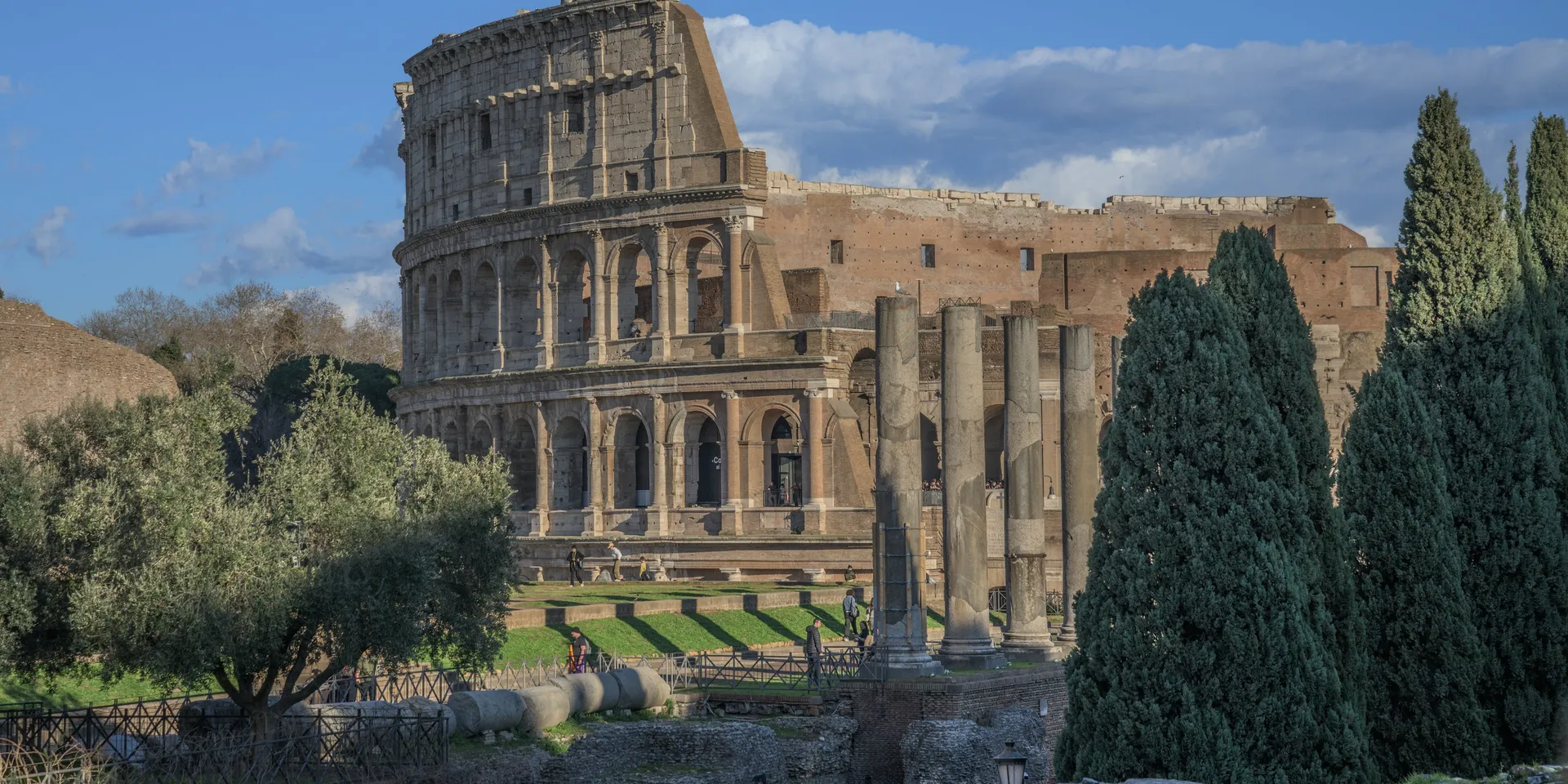
Day 2 — ancient Rome, on one ticket. Put the Colosseum slot at opening, then walk the Forum and climb the Palatine on the same €18 ticket while it is still fresh. The three sites sit beside each other, so the day holds together on foot. Book the slot online up to 30 days ahead; in season the prime morning slots go first.
Day 3 — Vatican City. One anchor, half a day: the museums, then St Peter’s, then the long walk back across the river at dusk. Reserve a timed entry in advance in high season and keep the afternoon unscheduled; the Trastevere side of the river is the evening.
Day 4 — Rome’s ordinary life. A market morning (Testaccio or Campo de’ Fiori), one church or gallery, and the slow streets in between. This is the plan’s pressure valve in Rome: if day 2 or 3 slipped, day 4 absorbs it before the trip moves north.
Days 5–7: Florence and Tuscany
Day 5 — the 1h30 move north. A morning train from Rome to Florence is short enough to waste nothing: from-fares start at €14.90 (Italo, checked 28 October 2026). Check in, then the Duomo square in the afternoon light and the view from Piazzale Michelangelo at sunset.
Day 6 — Florence’s big rooms. One museum anchor, not three: the Uffizi for painting or the Accademia for Michelangelo’s David, reserved in advance. The rest of the day is Oltrarno’s workshops and the riverbank. Florence rewards depth over checklists; the city is small enough that wandering is the second museum.
Day 7 — Siena, or the slack day. Siena is the classic day trip by bus or regional train, and the tower-and-piazza medieval center is a half-day done honestly. If the trip is running tired, this is the built-in rest day: nothing on day 8 depends on it.
Days 8–10: Venice and the flight home
Day 8 — the 2h15 move to the lagoon. The morning train from Florence reaches Venice in 2h15 with from-fares at €18.90 (Italo, checked 28 October 2026). Ride the vaporetto in instead of the shuttle, check in, and give the evening to San Marco once the day crowds thin.
Day 9 — Venice on foot, one quiet sestiere. San Marco and the Doge’s Palace early, then pick one residential district — Cannaregio or Dorsoduro — and walk it without a list. Venice’s best half-day costs nothing and needs no reservation, which balances the ticket-heavy first week.
Day 10 — fly home, no excursion. The whole morning is breakfast, bags, and the trip to Marco Polo. Nothing scheduled, nothing booked. If the flight leaves from Milan Malpensa instead, the Venice–Milan leg runs 2h15 with from-fares at €14.90, and the departure-day discipline stays the same: the extension is the only thing on the agenda.
Ending at the far end of the corridor is what buys that empty day. A plan that loops back to Rome spends its last day on a 3-hour-plus backtrack; this one spends it on the flight.
Turning this 10-day Italy itinerary into a client-ready trip
For agency owners, this plan is a starting structure — the client-ready version carries confirmation numbers, the client’s local times, and the bookings from their own documents. Advisors on r/travelagents and r/FATTravel describe full custom itineraries as their paid work, with planning fees around $250–350 as a base rate for 7 days in one widely-upvoted thread (r/FATTravel, community forum data — not a survey, read as one data point). Ten days in Italy is squarely that work.
And the client’s expectations are set by the tools they already use: 87% of travelers say they like to leave room in their itinerary for unexpected local discoveries (American Express, 2026 Global Travel Trends Report, checked 20 October 2026) — which is what one anchor per half-day builds in.
Three moves turn this into the deliverable:
- Import the bookings, don’t retype them. With booking import, the client’s flight, hotel and train confirmations become a day-by-day draft you review and publish.
- Check the two entry risks before check-in. The arrival-time calculator catches the timezone error on the Venice flight; the passport validity checker catches the Schengen three-month rule before the airline does, and our ETIAS guide for travel agents covers what to tell clients about the application itself.
- Deliver it where it survives the trip. A PDF prints well; an app updates. The traveler app works offline on the client’s own phone, under your agency’s brand. Pricing is flat per agency. (Full disclosure: we make Viaondo, so read the craft above as craft and judge the tool on the 14-day free trial.)
The blank version of this format is the free itinerary template, and the same pattern in Japan is our Japan itinerary for 10 days.
Sources
- Italo — train routes (Rome–Florence 1h30 from €14.90; Florence–Venice 2h15 from €18.90; Venice–Milan 2h15 from €14.90) (accessed 28 October 2026)
- Trenitalia — Leonardo Express (Fiumicino–Roma Termini, 32 minutes, every 15 minutes, €14) and Regionale ticket validation rules (accessed 28 October 2026)
- Parco archeologico del Colosseo — standard ticket €18 (Colosseum levels 1–2 with terraces and museum, Roman Forum, Palatine Hill; 24-hour validity; timed entry; online booking opens 30 days ahead) (accessed 28 October 2026)
- Eurail — Eurail Italy Pass (from €124, cheapest option 3 travel days within 1 month) (accessed 28 October 2026)
- American Express Travel — 2026 Global Travel Trends Report (87% leave room for discovery) (accessed 20 October 2026)
- Reddit r/FATTravel — planning-fee thread (community data, labeled as such) (accessed 26 October 2026)