Which Travefy alternative should you choose?
Choose by the reason you’re leaving, because no single tool fixes all of them. This table matches each reason to the tool that answers it and to what you give up. The reasons come from Travefy’s own public pages and prices, not from a survey of people who left.
| Why you’re looking | Pick | What you give up |
|---|---|---|
| The bill grows with every hire | Viaondo, if you sell and invoice elsewhere | CRM, proposals and invoicing |
| You want a suite, for less, alone or with a small team | TravelJoy Pro | A client app that lists English only |
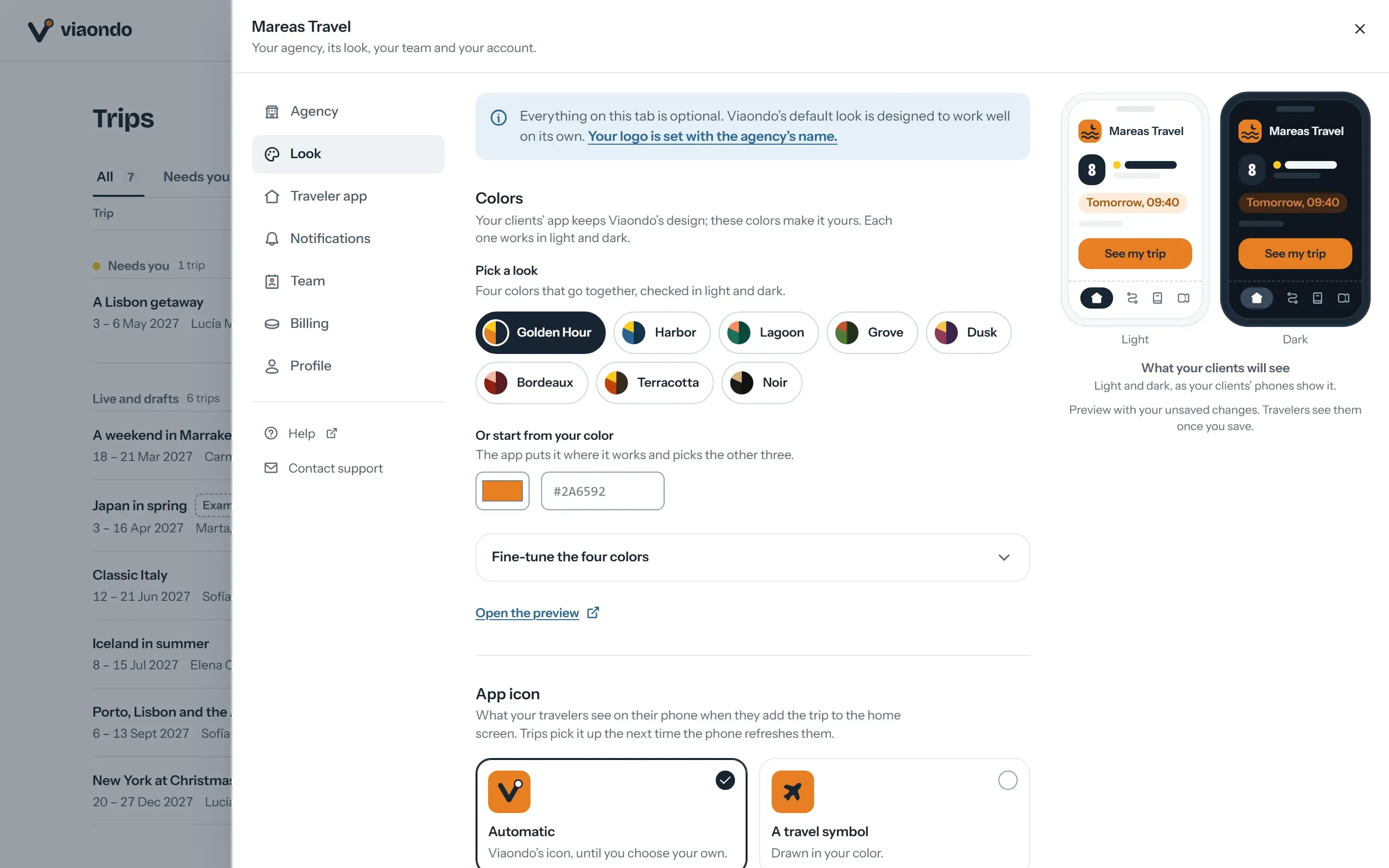
| You want your brand on the client app, with no download, sign-up or enterprise quote | Viaondo | A listing in the app stores, in-app chat and flight alerts |
| You want your own app in the stores | mTrip White-Label, or Vamoos’s branded version | A public price; on mTrip, a setup fee and a one-year commitment |
| Clients read languages other than English and Spanish | Viaondo (ten), Vamoos (eleven), mTrip (nine) | Vamoos starts at £240/month and mTrip at US$200/month |
| You want supplier content, payment authorization and commission reconciliation | Tern | Still per seat, and the 3 to 24 seat tier goes through sales |
| You build trips with DMCs or from GDS PNRs | Axus | Still per seat, and data stored in the United States |
| You want data hosted in the EU | Viaondo | Everything above that Viaondo doesn’t do |
Travefy’s pricing page doesn’t state where data is stored. Trip Plans is unbranded on purpose, and Travefy’s agency page says it shows the advisor’s logo with no Travefy branding. An app under your own name is an enterprise service quoted on request. The App Store listing shows English and Spanish.
How much does each option cost at 1, 3 and 10 people?
Alone, Viaondo isn’t the cheapest: Axus, TravelJoy Pro, Tern and Travefy Core all cost less on annual billing. From two people, its flat price is the lowest sticker price here, and the gap widens with each hire: ten people on Travefy Core pay $2,628 a year against $500.
Billed annually, in dollars a month, before tax:
| Plan | 1 person | 3 people | 10 people |
|---|---|---|---|
| Viaondo (ours) | $42 | $42 | $42 |
| Axus | $27 | $82 | $274 |
| TravelJoy Pro | $32 | $62 | $167 |
| Tern | $35 | $75 | $250 |
| Travefy Core | $39 | $79 | $219 |
| Travefy Premium | $59 | $137 | $410 |
Billed monthly:
| Plan | 1 person | 3 people | 10 people |
|---|---|---|---|
| Viaondo (ours) | $50 | $50 | $50 |
| Axus | $35 | $105 | $350 |
| TravelJoy Pro | $39 | $69 | $174 |
| Tern | $49 | $99 | $330 |
| Travefy Core | $49 | $119 | $364 |
These totals are our arithmetic from each vendor’s published rates, checked on 5 November 2026. Read them with these limits:
- They aren’t like for like. Travefy, TravelJoy and Tern include a CRM and invoicing. Viaondo doesn’t, so if you’d have to buy a CRM to go with it, add that price to its row.
- Travefy’s monthly rate isn’t on its pricing page, which says only that a monthly option exists. The $49 base seat and $35 extra seat are from its help center article on team pricing, dated 25 November 2025. That article gives no monthly price for Premium.
- TravelJoy’s team price isn’t on its pricing page either. The $15/month per team member is from its February 2025 announcement. Confirm it before you count on it, especially on annual billing.
- Tern’s 3 to 24 seat rates ($25 billed annually, $33 monthly) are published, but that tier’s button is “Talk to Sales”. Travefy’s Agency plan and Axus’s team pricing also go through sales, so a real quote for ten may differ.
- Viaondo’s flat price covers teams of up to ten users under its fair use terms. Above that, the price is a conversation.
- Vamoos and mTrip aren’t in the tables because they don’t charge by seat. Vamoos starts at £240 or €283/month + VAT for up to 500 passengers a year. mTrip charges by itineraries sent: its pricing page says it has no public rate card, while its software guide starts Trip Agent at US$200/month and quotes White-Label after a demo.
- Travefy has lower rates for some buyers. Its New Travel Agent Program is $25/month, and Travel Leaders Network members get 15% off annual plans, so Core is $33/month.
The same math for more vendors is in the price index, and every Travefy plan is in Travefy pricing.
When should you stay on Travefy?
Stay if you run sales and billing from Travefy every day, or if you work alone and price is your only reason to move. A daily user would have to rebuild how they work. A solo user would save about $12/month at most on an uncapped plan, $139 a year, which rarely pays for a move. In detail:
- You invoice and track commissions in Travefy. Moving trip delivery alone to a tool like Viaondo would leave you paying for both.
- You work alone. Billed annually, Core is $39/month. Axus ($27), TravelJoy Pro ($32) and Tern ($35) cost less, and Viaondo (about $42) costs more with no CRM. The largest saving is $139 a year, against Axus. TravelJoy Starter ($19) saves more but stops at 12 trips a year, and new advisors pay $25/month on Travefy.
- You’re a team of two or three that uses the whole suite. Core for three is $79/month. Replacing the CRM, proposals, website and invoicing elsewhere will likely cost more than the seats you’d save.
- Your clients like Trip Plans. Travefy says it gives them flight notifications, chat with you and offline access, in a store app. Viaondo has no chat or flight tracking.
- You need a custom domain or business email. Premium includes both. Viaondo has neither.
- You rely on the Agency plan’s back office: commission and revenue reporting, supplier management and a dedicated account manager.
What do you lose by leaving Travefy?
It depends on where you go. TravelJoy and Tern replace most of the suite. Axus, mTrip, Vamoos and Viaondo focus on the itinerary and the client app, so with them you’d lose:
- The CRM, proposals and invoicing, with forms, automations, commission tracking and email integration. (Axus and mTrip connect to outside systems instead.)
- Websites and landing pages built in the same account.
- Premium extras: phone support by call back, a custom domain and business email hosting.
With Viaondo in particular you also lose the store app, its chat and its flight notifications. The row-by-row detail is in Viaondo vs Travefy, and suite against suite in Travefy vs TravelJoy and Tern vs Travefy.
How do you switch from Travefy?
Export what you can before you cancel, and rebuild upcoming trips from their supplier confirmations, because Travefy’s help center documents no itinerary export to other tools. Travefy’s help center guarantees your data for only 45 days after you cancel, and it may be deleted after that. Moving to Viaondo, step by step:
- Export first. Download your contacts as a CSV (on a team, only the admin can) and save a PDF of each trip you still need.
- Start the trial. Create your account, start the 14-day free trial and set up your logo, colors and WhatsApp number.
- Collect the originals. Take the supplier confirmations for your next departures from your inbox or supplier portals. Viaondo doesn’t read Travefy itineraries.
- Upload them. The bookings go into the trip’s draft, each with the document it came from; anything Viaondo couldn’t be sure of is listed under To confirm.
- Let current trips finish. Trips already in Trip Plans stay there, so no client changes apps mid-trip. New trips arrive as a link, with nothing to download.
- Publish and invite your team by email once the first trip has gone out. The price doesn’t change when they join.